Your ‘frequently asked questions’. Please contact us if there’s something we should be explaining here.
Each match follows a “formula”, that states who races in each heat and which of the four grids they start from. There will be a draw to decide formula numbers for individual matches. Team managers assign their team numbers to their riders before a match
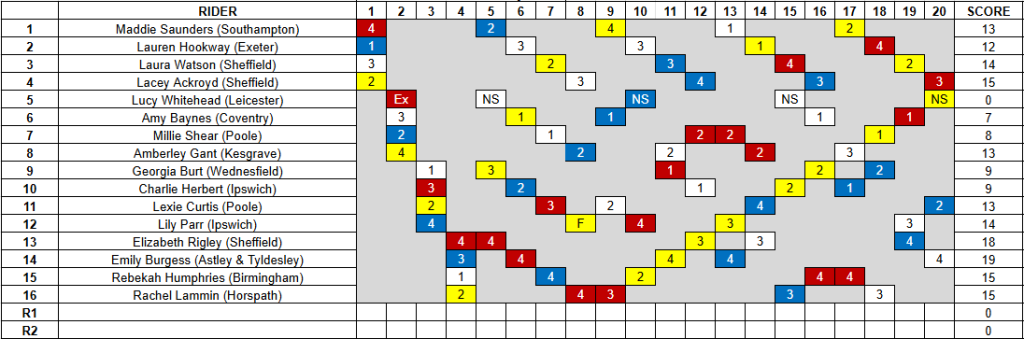
In this example the colours represent grid numbers, the numbers are points scored during that race.
Individual matches, where riders compete with all other riders including their own club mates, can be scored two ways:
- heat points are added to produce a total score for the match. This is the most common way to decide a one-off meeting such as a Championship, but can also be used for leagues throughout a season.
- heat points are added to produce an order of riders, who then ride ‘GP Finals’ to determine their match score, from 20pts for the ‘A final’ winner to 1 pt for 4th place in the ‘D final’. This GP system is commonly used to score points for leagues, and ensures the Finals are raced by similarly matched riders.
There are two factors in team racing:
- how many riders in a team?
- how many from each team ride in each heat?
Teams may be 2 rider (“Pairs” or “Best Pairs”), 4 rider, 6 rider or 8. Each formula can have reserves, who can be substituted in to a race before it begins – to share rides, or to use your star rider(s) tactically.
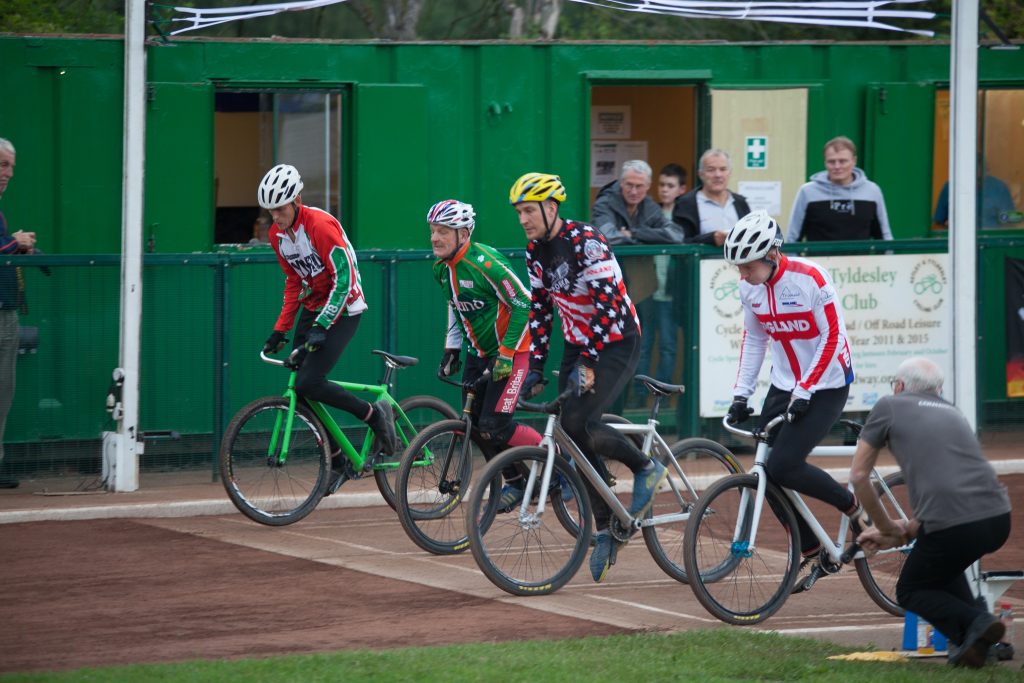
In Pairs racing, and 6/8 rider team racing, 2 teams will each have 2 riders in a heat; either taking grid positions 1 and 3, or 2 and 4. In Fours racing, fours teams will have one rider each in the heat.
Get involved
Good choice. See our “Clubs and Regions” page to find your local club, and contact them for details. If you’re having issues then please contact us.
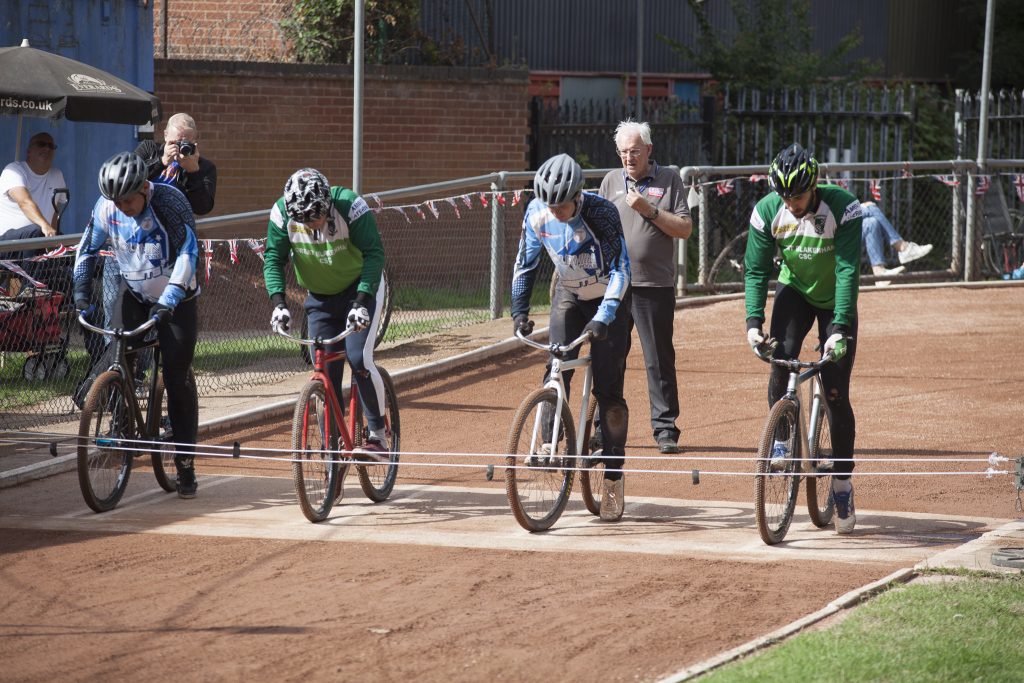
You’ll need to be covered from the neck down. Long sleeves and tracksuit / goalkeepers trousers, or similar. Trainers, and socks that cover ankles. Most clubs will lend you long fingered gloves and helmets, or bring your own.
Most clubs can lend you a bike. Many riders want their own though.
Typical ‘full size’ bikes are ridden from around 13 years to adult. They will have 26″ or 27.5″ wheels, and 50cm to 54cm frames. The smallest CS-specific bikes have 24″ wheels, younger riders adapting BMXes or other bikes.
The bikes are small and nimble compared to other types. Riders should be able to comfortably plant a foot on the ground, and not stretch to the handlebars. Youngsters like to get onto bigger wheels for lower rolling resistence; 26″ is the most popular compromise for speed, acceleration and maneuvourability.
[add content on suppliers – Bob’s supplier, Exeter, Poland, C.Timms, Pedal Power]
Check out our Clubs and Regions page for links to each club’s web site, Facebook and Instagram pages.
Our online magazine is 3318 news (the name comes from the usual gear ratio of a CS bike), who also have a Facebook page, below.
Matches are often live-streamed on Facebook, and archived on Youtube. To see if a match is being streamed, ask on the hosting club’s Facebook page or try one of the groups below. Global Cycle Speedway Network is our largest video channel on Youtube.
Most discussion is on Facebook, though there are active pages on Instagram also. Some of the more popular ones are:
- The Federation’s own Facebook page
- 3318 News, magazine and news
- Global Cycle Speedway Network, magazine and news, live streaming
- CS Women’s League, news and reports
- CS National League, news and reports, live streaming
- CS International Championships, news and links to live streaming
- England Junior squad, news announcements and results
- “I was (or still am) a CS rider”, for the nostalgia and contacting your old team from the 1960’s
Pleased to hear it! Please contact us. The CSF provides support in training volunteers, advice on facilities and tracks, and insurance and safeguarding framework for training for and racing CS.
CS is the ideal introduction to cycle sport. Affordable, low risk, easy to set up