Cycle Speedway is an all year round sport – outdoors from March to October with an increasingly popular indoor season over the winter months. It is one of the most exhilarating sports and open to all.
The outdoor track
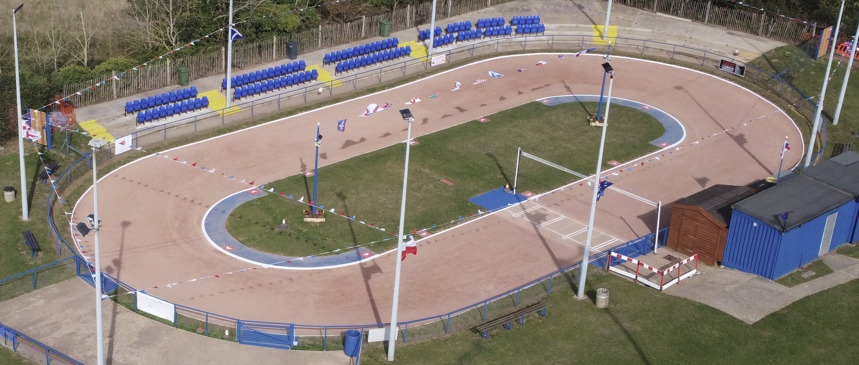
At the heart of CS lies a short oval track around 70-90m in circumference. The surface of the track is traditionally red shale, but other materials are sometimes used, from manicured surfaces – with banking up to 10 degrees – to simple, temporary, set-ups on grass. Safety fencing around the permanent tracks provides a safe environment for spectators and younger children. A growing trend is for Multi-Use tracks, where other sports can also take place.
There is typically one CS Club per track, which looks after the facilities including the clubhouse, cycles and other equipment, and builds a healthy community team.
So what can you expect?
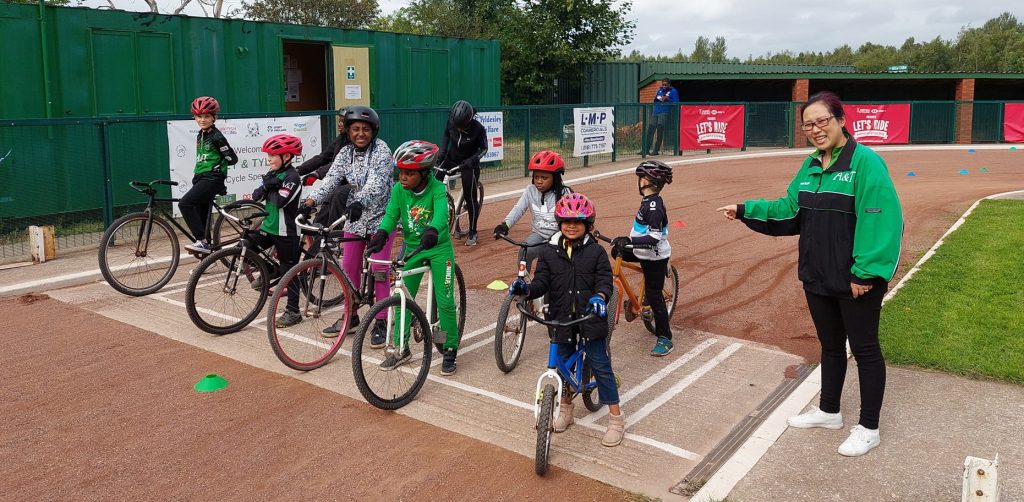
Clubs vary, but expect some or all of the following;
- A warm welcome for anyone. We caters for all abilities (and some disabilities) from age 3 to 80+. Often whole families, including grandparents take part at different levels – some learning, some racing and some volunteering.
- Early Years: Younger children from around 3 to 6 years old doing simple drills on a bike – balance skills, riding safely, cornering, riding alongside others, being timed for a couple of laps, having simple races etc. The objective is to gradually build enough confidence to race each other and, if they choose, enter competitions. The first age category is for Under 8s. We are always surprised at how quickly even 3 year olds become competitive and want to know their times and grades!
- Junior Riding: increasing emphasis on training and racing skills, with coaches running a variety of activities based on the abilities of the riders. Coaches will be keen to encourage riders to take part in competitive events. These can be team or individual events and run all the way up to National Championships.
- Youth, Senior (Women and Open) and Veterans (over 40’s and over 60’s): The focus is more on training and racing. For some, the healthy training is enough, for others the attraction is serious racing against local, regional and national competition in their category. Training includes how to start fast, how to corner efficiently, accelerate quickly, choose a good race line and team ride. It quickly builds fitness – CS is classed as HIIT (High Intensity Interval Training) viewed as highly effective and beneficial for fitness, fat loss, and cardiovascular health. Many over 60’s can beat most riders that are 40 years younger!
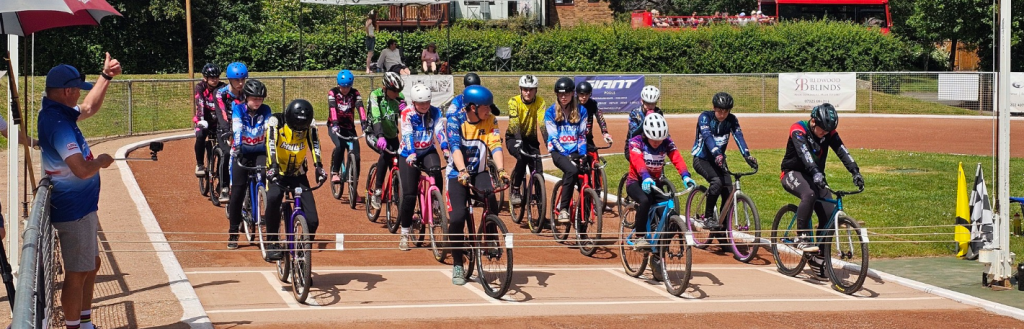
Events involve multiple races, and riders can anticipate riding 4 or 5 races over an hour or so. Races are normally over 4 laps with 4 riders from a stationary start, and take around 45-60 seconds each. These events can be inter-Club – with each Club having 6 to 8 riders – or individual events. Various Regional and National Leagues exist (e.g. a separate Women’s League) to cater for the wide range of rider ability. The videos here best illustrate what it is about.
All sports carry some risk. At the early years and junior level that risk is probably a lot lower than riding in a public space, and certainly than on the road or even a car park. Occasional tumbles from the bike are to be expected. As one progresses through to the senior level, rider to rider bodily contact is part of the sport and crashes do happen, but rarely with any injury. As the tracks are short, the speeds are not high; the sport is more about fast acceleration than top speed. Serious injuries (broken bones etc) are very rare but scrapes and bumps can be expected from time to time, particularly in the more senior elite races; In 80 years the sport has never had a fatality! The rules of the sport are well documented and refereed to minimise risk. Riders must wear approved helmets and be clad from the neck down. Padding is optional.
The CS bike is deliberately a simple and low cost beast. A lightweight frame, short wheelbase, one freewheel low gear, no protrusions or accessories, and no brakes (so no sudden stops). This maximises safety, keeps costs down, and allows the bike to accelerate quickly. For the younger age groups these bikes are usually built from stripped down children’s bikes. At the more serious senior end of the spectrum there are more specialised builds but these are not essential to compete.
For some the feel-good from training alone is enough. For most it is the thrill of racing. Four riders lined up, muscles tensed, eyes on the tapes, and then whoosh they are off into the first bend, jostling for position. Which line do I take? Where’s my team mate? How do I get past the rider in front. It doesn’t last long, but it’s exhilarating, requires fast reactions, rapid decision making and quick acceleration. The adrenaline soon gets pumping. Then it’s a rest of a few minutes and then off on the next race against different opponents – so being fit enough to recover quickly is a key advantage.
CS is a low cost and accessible cycle sport. The annual charge from clubs is typically below £100 and paid in instalments – so less than £10/month. The bikes can often be provided by the club.
Your own bike can range from £200 to £700 at the high end. Clothing is simple; be covered from the neck down, with long fingered gloves. A good quality helmet is the most important thing.